There’s a fleeting freshness to information these days—so fleeting, in fact, that its usefulness often has a half-life of about 20 minutes. That sounds about right. Once something is said out loud, especially in the world of fast-moving markets and fast-talking pundits, its edge dulls quickly. If it’s coming from a so-called “credible” news source, odds are it’s already been picked over by the big players, scrubbed clean of its originality, and handed down like day-old bread.
So, what’s a sharp young or older thinker to do?
Well, you’ve got choices. You could toe the line, contribute to the success of those already firmly planted at the top, and nod along with the script. Or, you could take the hits that come with thinking for yourself. It’s the classic choice: comfort or clarity. The “road less traveled” might bring wisdom, but it also comes with raised eyebrows and the occasional scorn. And if you dare to walk that path, best to walk it quietly—because secrets don’t stay secret for long, especially if more than one person knows.
Here’s the thing: believe only what your eyes show you,
and be suspicious of everything else. Trusting what you hear—especially when it’s shouted through a megaphone—leaves you vulnerable. Nobody gives away profitable secrets without a price. If they do, it’s either not a secret anymore or it’s not profitable.
So in a world screaming for your attention, try a different approach:
Cut through the chaos and spot the real trends—ignore the distractions.
Don’t fall for sensational headlines designed to provoke fear or greed.
Stay cool-headed while the masses spiral out of control over the news cycle.
The bottom line? Trust your eyes. Trust your own mind. Gather information with your own effort, through your own sweat. If you didn’t earn it, don’t count on it. Insight isn’t given—it’s ground out, tested, and earned. And its value is directly tied to what you paid for it: time, effort, thought… sometimes even heartache.
In this 20-minute world, your clarity might just be your greatest edge.
In the volatile world of mining stocks, there’s a saying that’s ringing loud and clear right now:
“Gold sneezes, and the Junior miners catch pneumonia.”
And it’s never been more true.
What Are Junior Gold Miners, Anyway?
Junior gold miners aren’t the giants like Barrick or Newmont. They’re not even mid-tier producers.
They’re the dreamers.
These companies focus on exploration — staking claims in remote greenfield areas or digging into abandoned brownfield sites, hoping to strike gold. Literally.
They don’t produce gold (yet). They hope to prove that the land they’re testing has economically viable deposits. If they get lucky — and if they have the money, infrastructure, permits, and partners — they might develop into an actual mining operation one day.
But statistically? It’s a long shot:
Only 1 in 1,000 deposits becomes a mine.
Maybe 10 out of 1,000 ever become profitable.
Why Are Juniors Getting Hammered?
Here’s what’s crushing the juniors:
No gold output → No revenue.
Little infrastructure → Everything’s expensive and slow.
Unproven management → Few industry veterans leading the way.
The legendary backers like Rob McEwen (Goldcorp), Eric Sprott, and Pierre Lassonde (Franco-Nevada) are sitting on the sidelines. Even the majors — Barrick and Newmont — aren’t sniffing around the junior space. That’s a warning sign in itself.
It’s a Numbers Game (And the Odds Are Brutal)
Let’s be honest: Junior gold miners are some of the riskiest plays in the market. There’s an old industry quote you’ll hear at any mining conference:
“More money is put into the ground than will ever be taken out of it.”
Exploration and development cost a fortune. And the odds that you’ll find a deposit, raise enough cash, clear environmental reviews, secure water rights, and still make it profitable? Slim.
The Real-World Obstacles
If you’re wondering why junior miners struggle to even get started, here’s a short list of what they’re up against:
🛑 Lack of capital for exploration and drilling
💰 Sky-high equipment costs
🌱 Environmental regulations and compliance
💧 Water management challenges
👷 Shortage of experienced personnel
📜 Bureaucracy and jurisdiction risk
🧪 Geological research and testing
🏔️ Rough terrain and unpredictable conditions
If you asked Kevin O’Leary what he thinks of junior miners, you’d probably get a quick “No thanks.”
So… Are They Doomed?
Not necessarily. Some juniors do succeed. A lucky few strike gold and ride the wave all the way to the top. But most?
They’re money pits.
Without deep pockets, powerful backers, or extraordinary luck, the road from discovery to production is more of a tightrope walk over a pit full of expenses.
Gold might glitter — But for Junior miners? They’re bleeding just to get a glimmer.
Like this post? ➡️ Share it with a fellow investor. 📩 Subscribe for more market insights and real talk on mining, gold, and beyond.
Some days are just great days — and this was one of them.
Brilliant sunshine. A deep blue sky with wisps of white clouds hanging in the middle like a painting. The kind of day where even lunch with friends feels a little more special, a little more alive.
After we said our goodbyes, it wasn’t even a question — we headed due south for the lake. Lake Erie. It seemed like everyone else had the same idea, too — the first really nice weekend of spring had traffic buzzing at full speed. But once we veered off onto the secondary roads, the pace relaxed a little. The countryside rolled out around us, peaceful and green. We even passed a few Mennonite buggies making their way home from Sunday services, a reminder that spring’s return isn’t just about nature waking up — it’s about traditions carrying on too. One of the best parts about getting out of town is shaking off the constant hum of the electronic world. Out here, no pings, no notifications. Just the land, the sky, and the simple beauty of it all. Nature was putting on a quiet show: a hawk perched tall in the trees, likely preparing to raise their young.
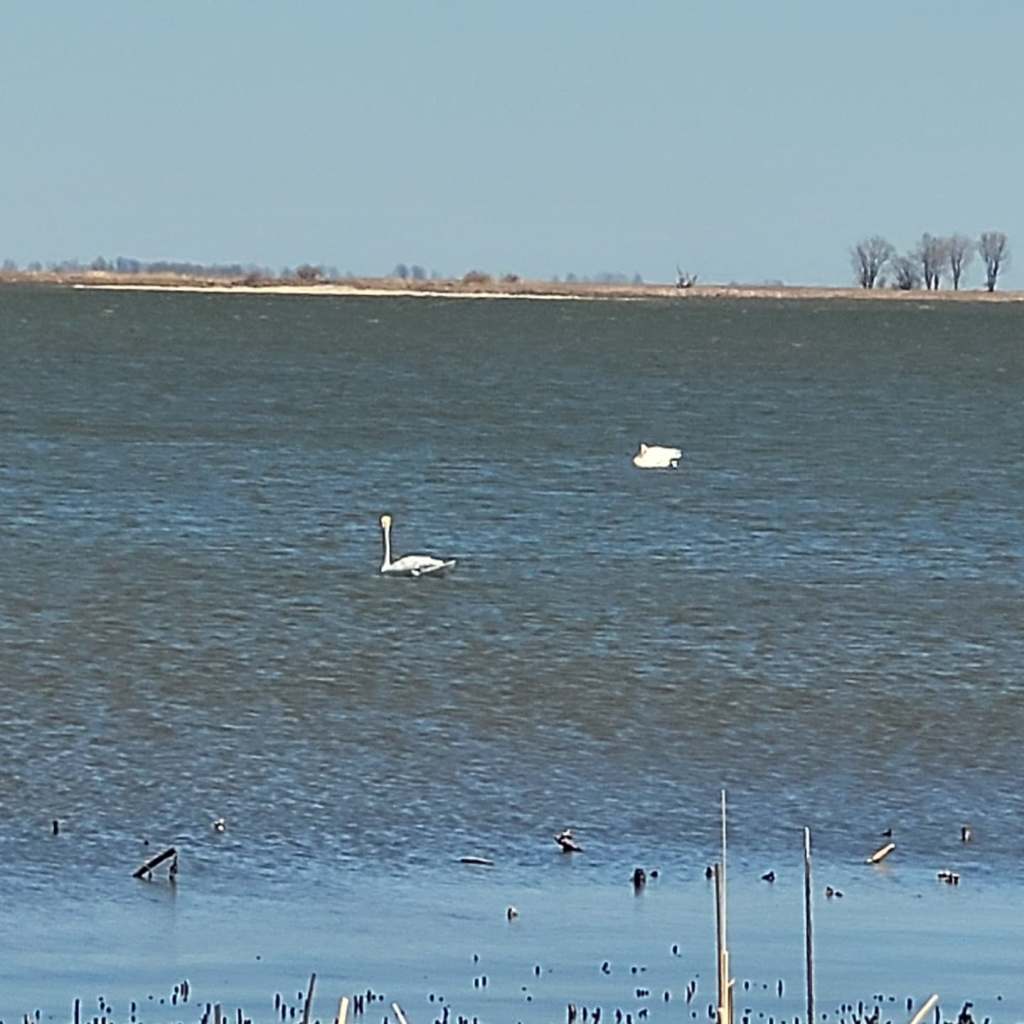
By the time we reached Long Point — a tiny town stretched out over a 5-mile spit into the lake — it felt like we’d truly arrived. The place was alive with birds, returning to nest and raise families of their own. Swans drifted lazily through the marshes, and we were lucky enough to spot a nesting bald eagle close enough for a good photo. The lake itself churned a bit over the shallow clay beds, but farther out, the water deepened into stunning, vibrant blues, shining in the afternoon sun.
It was a good plan: a destination, a meal, and an overwhelming sense of natural beauty. Perfect for a Sunday. Perfect, really, for any day you want to slip the bonds of routine and breathe a little deeper.
Sure, it’s easier to wax poetic about a day trip when the weather is good. But even in shoulder seasons, even when you’re waiting out the threat of tornadoes or bad storms, getting out — even just an hour away — can do wonders for the spirit. Back when we lived up in the Addington Highlands, a trip to the orchid plantation was about as far as we could go. Some seasons we’d go looking for bunny shows. Now, we keep an eye out for sheep farms and spring shearings. You just never know what you’ll stumble across (not roadkill, thankfully) when you take a simple ramble through the countryside.
There’s a world of places waiting, even if they weren’t part of your stomping grounds growing up. New traditions can start any day. New rituals, new friendships — they’re all out there.
As we arrived home we were reminded that our resident carport sparrows are back, faithful little things, starting their fourth brood. There’s a comfort in their return, a sense of home that doesn’t need anything flashy.
We’re making it our intention to plan new destinations, to keep bolting from the routines of urban life when we can. And honestly? We hope you’re out there too, enjoying the world in all its wide-open beauty.
📈 NO-DIRT STREAMER: A First Look at Royalty Streaming
Let’s start with the basics: Mining for gold or silver is pretty straightforward—you dig in the dirt, haul it up, and pour chemicals over the crushed rock to separate out the good stuff.
But with royalty streaming, you don’t dig. You don’t pour chemicals. You don’t move a speck of dirt.
Instead, you take a slice of the action.
Unlike certain unnamed criminal organizations, royalty streaming companies take legitimate periodic payments—either in lump sums or installments—based on the value of the minerals extracted, especially those non-core by-products found while miners are chasing gold or silver.
The Concept: Momentum & Trends
Let’s also accept a key market concept:
Trends run on inertia. They continue until their momentum dies out. And when they’re near the end of their run, they get confusing.
Think of momentum like a Ford Windsor 351 cubic inch engine. Take your foot off the gas, and it slows—not because something broke, but because fuel stopped flowing. The market’s the same. When the trend loses its fuel—news, sentiment, money flow—it stalls out.
So how do we read the signs before the slowdown?
The Play: Royalty Streaming
Take ELE as a case study. They’re receiving payments from a group of miners extracting gold, silver, and other valuable by-product minerals. The trick? These by-products aren’t the main show. But their value still tracks with the price of gold.
And while gold and silver prices rise, the royalty streamers benefit—without digging a hole.
Key Factors: Location & Duration
There are countless moving pieces, but two of the most important ones are:
Jurisdiction — Would you rather hold a contract in the DRC or the Commonwealth of Canada? How about Argentina vs. Australia? Stability and local governance affect risk—and reward.
Contract Term — These deals don’t last forever. It pays to know when they expire—and how much upside remains before they do.
While we can’t predict Acts of God or Force Majeure, you can hedge that risk by holding a diversified basket of royalty contracts. That’s the whole point of royalty streamers.
We’re launching something new. At the end of this month, look for our first NO-DIRT Streamer Letter—a deep dive into the top royalty streaming companies, with the best Technical Analysis charts I’ve got on their current setups.
$20 USD/month, money-back guarantee if you’re not satisfied.
Temperatures in the 60s (F) have been pleasant, but the past month has brought five days of rain and snow when this level was reached, with temperatures dropping to the 30s (F). We had to keep our big black and white Dutch buck outside.
Stepping out the door a day last week, I noticed a bird with the upright posture of a hawk. He or she, appeared to be eyeing the large black and white Dutch rabbit. Seems to me its white stripe down the midsection made it appear as two rabbits, prey sized for this hawk. The rabbit knew he was getting a stare. As I stared at the hawk, it took flight silently. Later the Dutch Buck, LeBron, was taken indoors.
*from Pintrest
Now while Spring may have sprung, I am used to seeing many squirrels hop past my window, usually black colouring in the majority. Funny this year the ratio dropped from favouring black over grey 6::1. This year something has changed. Gray now leads black, 2::1
Maybe hawks find it easier to identify the higher contrasting prey. Maybe.
Ah yes Spring, thoughts of growing things, and this year I have a garden of my own; no one to split the work or rewards with. Last year, in both our gardens we had raised beds. This year we each get one bed, 4 feet by 2 feet, 18” deep. Right now the media is barnyard horse manure. Given last years experience, I look forward to rearranging that, and replacing at least 50% of the manure with a lighter soil, loamy or like compost.
pic from Pintrest
A friend who is an award-winning gardener in our community expressed a bit of disappointment in my choice of plantings, all vegetable, and no flowers. The squirrels raised hades with the sunflowers and now, in light of their recent reduction and decimation, I may take heart and try and raise some.
I hope this spring gives you hope as it has me. DG
First Things First: Gold, Markets, and the Shifting Global Order
We’re living through the dismantling of the Westphalian system—the 17th century-old framework that shaped how nation-states operated, (which laid the foundation of modern state framework in Europe, especially in the financial realm. As that structure crumbles, commodities are starting to outshine financial instruments. It’s no surprise to those who’ve been watching: the system had to change or risk disintegration. The signs have been there since at least 2000, with the 2007–2008 financial crisis acting as a glaring red flag.
That crash wasn’t just a market hiccup. It was a generational collapse and a signal of massive tectonic shifts. Only a few recognized these shifts at the time. While pundits called it a “healthy rotation,” it was anything but. It ushered in the end of Western financial dominance. New trends emerged, including the BRICS alliance, de-dollarization, and serious challenges to the SWIFT system.
Gold’s Return to the Spotlight
Gold was long suppressed by complex market mechanisms. It started to break free thanks in part to new BIS (Bank for International Settlements) rules on collateral. Now central banks are engaged in the global arena. They are scrambling for gold. They are also trying to set prices favorable to their positions.
A recent coordinated short attack tried to shake the market. It took gold down from $3,130 to $2,965 (USD) between April 2 and April 7. A $165 dip can rattle a few weak hands. Nevertheless, it hasn’t changed the long-term fundamentals. These fundamentals have powered this gold bull since 1971. Price suppression was a band-aid—and now that it’s being ripped off, it’s taking some skin with it.
Big Players, Bigger Moves
The massive profits in mining have created an interesting dilemma. Production costs are under $900/oz. Prices are soaring. The top five producers, like those listed in the HUI, XAU, and GDX, are making serious money. We’re talking $2,000 gross profit per ounce and 16 million ounces total—roughly $320 billion in value. That’s enough to buy companies like Newmont and Barrick multiple times over.
And with market caps sitting around $70 billion combined, these mining majors could go on a spree—snapping up competitors like Agnico Eagle or smaller up-and-comers like Snowline (SGD.V). Even Pan American Silver, which now owns Yamana, is in the mix with a modest $10 billion cap. Bottom line: everything is up for grabs, and the gold rush is far from over.
Looking Ahead to $4,200 Gold?
If gold hits $4,200 this summer—and that’s not out of the question—the acquisition game will turn feverish. Bull markets are rarely rational. As bidding wars heat up, ask yourself: What’s your price? What would make you sell?
Remember the old adage: Bulls make money. Bears make money. Pigs get slaughtered. Know your plan and stick to it—don’t get shaken out by noise.
Stock Picks and Watch List
Before daylight savings time (March 9), these stocks were on the radar:
KGC (Kinross)
GTWO.TO (G2 Goldfields)
OMG.V (Omai Gold Mines)
TKO.TO (Taseko Mines)
CBR.V (Cabral Gold)
WPG.V (Western Pacific)
SNOWLINE (SGD.V)
SNG.V (Snowline Gold)
From tiny explorers to full-fledged producers, here’s a breakdown of current plays in the gold and silver mining space:
I. Developer
CNL Mining (CNL.TO) – Based in Colombia
II. Producer
Monument Mining (MMY.V) – Operations in Malaysia and Australia
III. Wild Card
BENZ Mining (BZ.V) – Projects in Quebec and Australia
Jurisdictions range from Quebec to Southeast Asia. For now, they look stable enough to hold risk at bay. How ever, nothing in this arena is ever guaranteed.
The Global Stage: A Jigsaw Puzzle in Motion
Europe is not exactly a calm place right now. The EU’s unity is cracking, with Germany flirting with dissent and countries like Hungary, Italy, and Austria making waves. Election results are becoming inconvenient for the elites, and that has them reaching for control levers.
On the global chessboard, the U.S. and Russia are in talks—a development that’s got smaller players (and their pundits) freaking out. The threat of nuclear war from Ukraine’s President Zelensky seems to be on pause. Yet, the Middle East continues to boil. A new U.S. cabinet has entered the scene, adding to the uncertainty.
Africa, once seen as off-limits, is now active again. Coups and conflicts are flaring up. Tragically, these events are costing lives as geopolitical pieces get shuffled.
Final Thoughts
We’re swimming in a sea of black swans and red herrings. It’s easy to get lost in the chaos. Sometimes the best thing you can do is step back and breathe. Wait for the pieces to fall into place, like a jigsaw puzzle slowly revealing its image.
This market isn’t for the faint of heart. It’s exciting, it’s confusing, and it’s moving fast. So do your own due diligence. Be wise, be patient, and remember: in this game, losses are part of the deal.
Like what you’re seeing here? Consider a paid subscription for details up-to-date mid-month and monthly updates.
Thank you for reading.
— Denaliguide
“Disclaimer Denaliguide and/or associates hold positions—long or short—in any of the stocks mentionedand are opinions only “










 Denaliguide Summit